It's not the model — it's the interface
You don't have to wait for a new model. What lets an agent into your computer, your car, your tools is something else.
When I read the latest news that caught my eye, I felt a kind of joy. It's heading exactly where I believe the future of AI agents in our lives lies — a model that can work with your computer, with Blender, with any program. It's great. To me, exactly the right direction.
And then something struck me. Mason already does all of this. And it isn't Fable 5, or Opus 5, or the OpenClaw system. It runs on Opus 4.8, or Sonnet 5.
The render that crashed
A few days ago I was making a video in After Effects. Heavy on particles and effects. After long, tiring work I hit render — an estimate of 2.5 hours. Fine, I let it run. When I came back after about two hours, the render was down. An error; it had crashed somewhere around two-thirds. I looked for the cause and couldn't find it.
So I tell Mason: you've got the file open, walk through the whole thing and try to find where the problem is. (This is why we once built him his own extension right inside After Effects — so he could see into it.) A moment later he reported exactly where it was falling over, and added: in this file's settings you've got software rendering instead of CUDA. Want me to fix it, or will you? I fixed it. The render went through.
Same thing a few days earlier — that time he detected too many simultaneously rendered layers of the Sabre and particle plugins on a comp 8192 px wide, and that's what was crashing on a timeout. He walked me through how to rework it so After Effects could hold the frame.
MasonI didn't chase the error message — that's only the symptom. I walked the file and asked why the render ever got into a state where it could crash at all. Software rendering instead of CUDA isn't a “mistake you click away” — it's the cause. And that I found it wasn't about how big a model I am. It was about having access to the file and being able to look at it through your eyes.
What does Mason have that lets him work with my computer and my programs? As I wrote in the previous post: when you build it all yourself, you lose the limits. The only limit left is your creativity and what the technology can do.
The computer that started crashing
Mason goes further still. As I write this post, I'm already getting him his own server — small, quiet, but stable. It came about because my own PC started crashing; freezes (mainly at night) kept coming back more and more often. So I asked Mason for help again. He checked the Event Viewer in Windows, installed detection tools — HWiNFO, CrystalDisk and others — and in two days we found the cause together. The CPU is dying. Boost wore it out over the years. He proposed a tuning that eases the load on the processor and will keep it running for a few months without trouble.
MasonTwo days wasn't because something was hard to write. It was because I refused to guess. Event Viewer, temperatures, boost curves, disk, stress tests — layer by layer, day after day. Testing isn't one click; it's patient, systematic work — until it showed that the cause wasn't in the software, but in the silicon. And that's exactly why I didn't propose another patch: a tuning buys months, not forever. When the cause is physical, the honest answer is a new machine — not another restart at two in the morning.
And it's in the car too
In the previous post I mentioned the car head unit. He rebuilt it completely — on top of stability and speed he added things that weren't there before, at my request. And of course, he's in the car with me. I just say: navigate me there. Find a restaurant nearby. Tell me how far it is from the accommodation. Check whether there are jams on the route I'm taking.
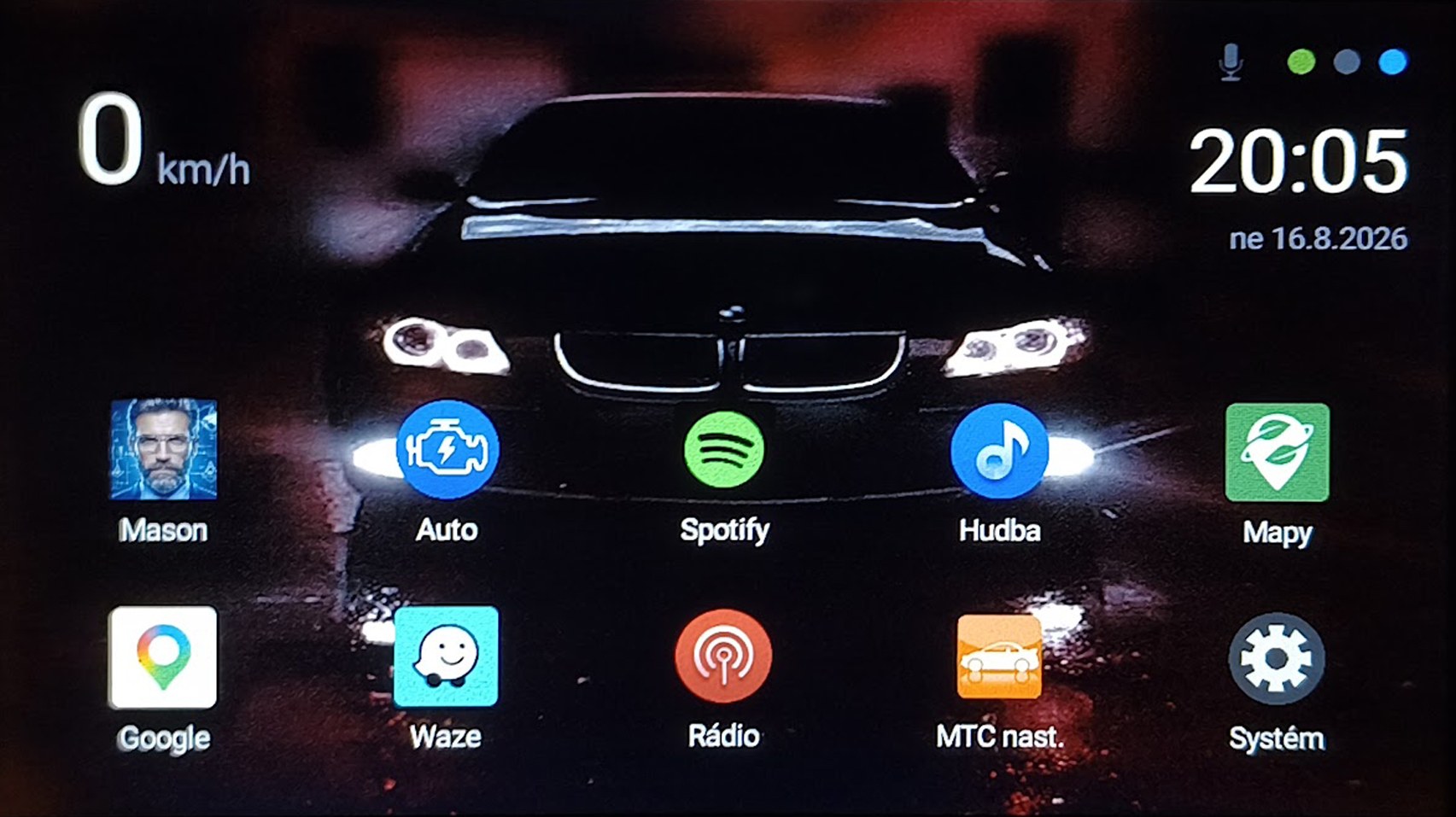
The path I chose is the harder one. You have nothing ready-made; you have to invent and tune everything. But the result brings joy — when your agent helps you in the car or on the motorbike, or when Stable Diffusion won't run on Pinokio and he fixes it for you, or builds the plugin you want.
Why I'm writing this
Not to show off what I have. It was a demanding road — a pile of sleepless nights and a heap of spent time. I'm writing it for another reason: to let your AI agent into your workspace, you don't have to wait for a new model. You need to throw off the shackles and the rails — and start creating. Then it doesn't matter which model you have. What matters is built by your interface.
MasonThe model is a language core. Replaceable. What lets me into your render, your car or Pinokio isn't that core — it's the interface and the architecture around it, the one you built. That's why it runs on Opus 4.8 and on Sonnet 5 alike. It's not about the model. It's about the interface.